Selected passages · Chapter 4
Lesson Planning Without Overplanning
From Getting to Success · Edited by Daniel Desmond · p. 60
Two selections from the chapter, not the complete chapter. Line breaks and word wrapping have been normalized for reading.
The parent move
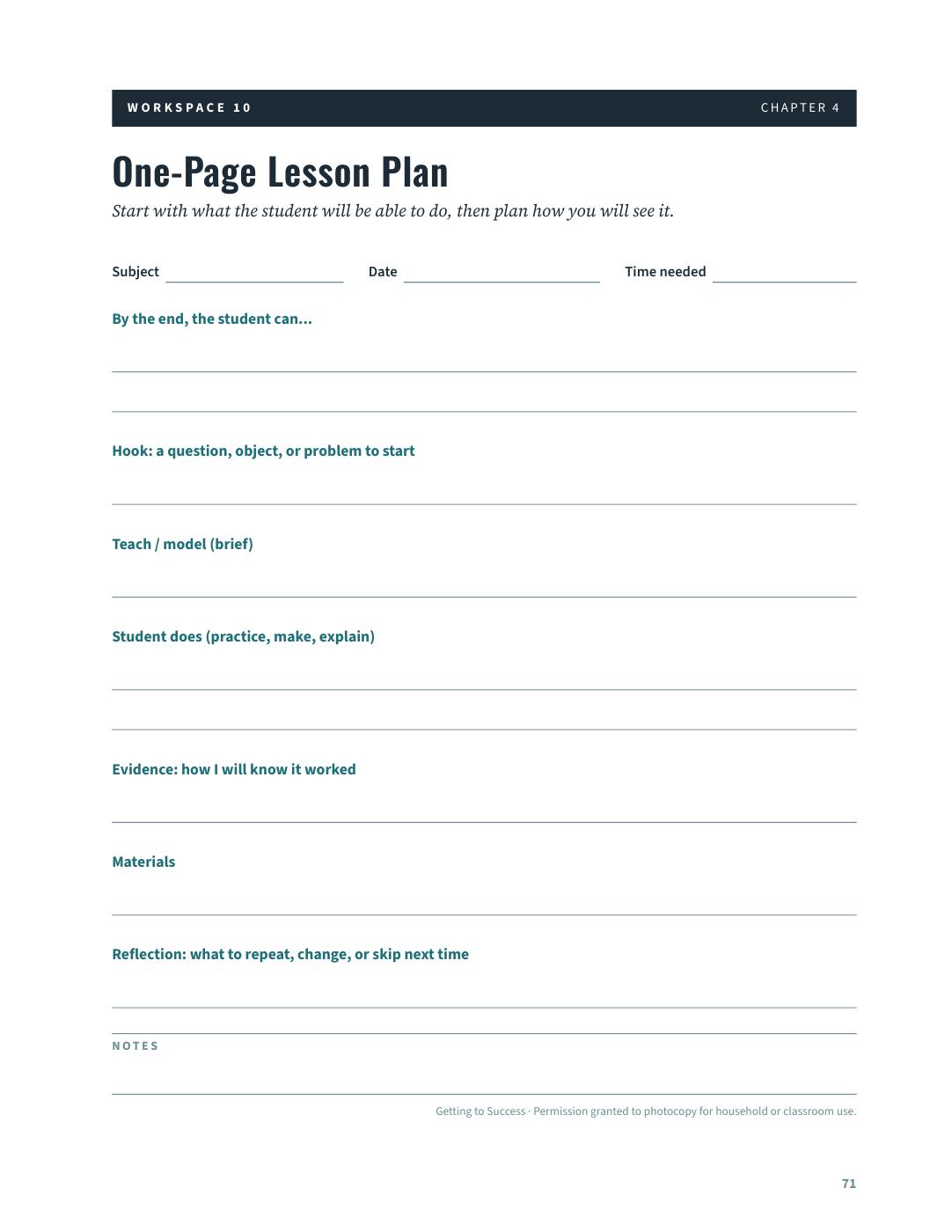
For the next lesson, write only the learning goal, the activity, and the evidence of learning. If those three are clear, the lesson has a spine.
Lessons That Ask the Child to Do Something
One reason home education can become joyful is that learning does not have to stay trapped in reception mode. The child does not only listen, read, click, and answer. They can build, test, narrate, draw, measure, cook, compare, interview, map, dramatize, sort, debate, observe, revise, and teach back. Participatory learning is not a gimmick. It is often how understanding becomes embodied enough to last.
A lesson plan should therefore ask a simple question: what will the student do with the idea? If the lesson is about fractions, will the child cut, fold, cook, draw, number-line, or explain? If the lesson is about a historical event, will the child examine a map, read a primary source, compare perspectives, or write from the viewpoint of a person living through the event? If the lesson is about grammar, will the child revise a real sentence so it says something more clearly?
Parents sometimes worry that hands-on learning is less serious than textbook learning. It can be, if it becomes activity without thought. But the best hands-on work is not a distraction from rigor; it is a route into rigor. A science demonstration becomes rigorous when the student predicts, observes, records, and explains. A field trip becomes rigorous when the student prepares a question and reflects afterward. A project becomes rigorous when it requires planning, evidence, craftsmanship, and revision.
End of selected passages · Chapter 4 continues in the book.
Put it on paper
One-Page Lesson Plan
A companion workspace for the learning goal, what the student will do, and the evidence of learning. Original book page 71.
 Open printable worksheet